
The End of Transformation
An Unconventional Enterprise Transformation Book
Iceberg Ahead — Why Your Organization Looks Right Until You Hit It
A new book by Thomas Walther
Stability no longer returns.
For decades, organizations have treated transformation as a temporary event: change the strategy, launch the program, reach the new state, and return to stability.
But what happens when stability never returns?
Markets keep moving. Technology reshapes industries. Customer expectations shift. Yet many organizations continue to rely on operating mechanisms designed for a world in which change eventually ends.
Under pressure, the consequences become visible. Decisions slow. Priorities collide. Coordination expands. Capacity fragments. Leaders increasingly compensate for systems struggling to keep pace with reality.
The End of Transformation examines why organizations that appear healthy can become fragile as conditions change—and what it takes to remain coherent while reality keeps moving.
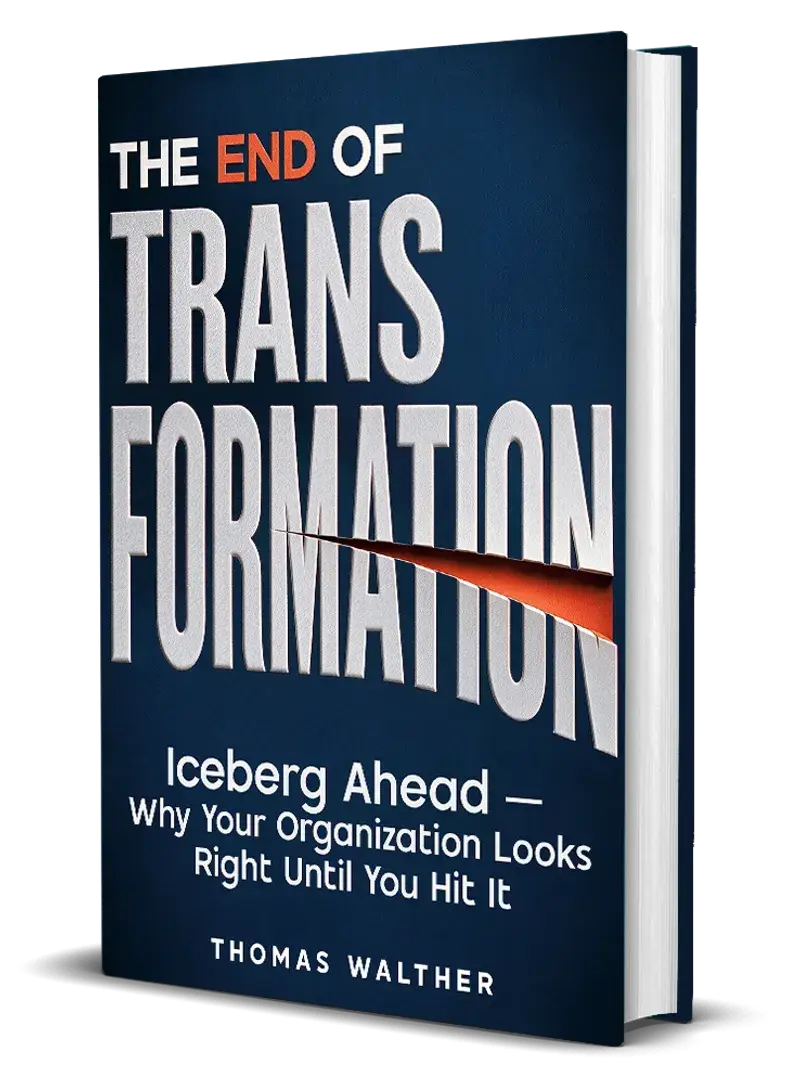
Get the Book Online
Who is This Enterprise Transformation Book For?
The End of Transformation was written specifically for senior executives, enterprise architects, and operational directors who are tasked with scaling complex organizations.
If you are managing legacy portfolios or driving rapid technological adoption, this unconventional enterprise transformation book provides the structural clarity you need to navigate systemic pressure.
Too often, leaders are handed theoretical frameworks that look great in a boardroom but fail upon implementation, leaving teams exhausted by endless change initiatives. This book is for those who recognize that traditional, temporary project management offices (PMOs) cannot govern reality.
It is designed for practitioners who want to stop outsourcing their execution and start building sustainable capacity from the inside out.
Whether you are a private-equity partner seeking to align a portfolio company's operating model or a seasoned IT executive looking to establish a shared structural language across siloed departments, this text in our unconventional enterprise transformation book bridges the critical gap between strategy and execution.
It is the essential blueprint for leaders who are ready to abandon start-and-stop projects and install continuous adaptation as a permanent organizational habit.
Core Themes and Practical Applications
Unlike theoretical leadership manuals, this unconventional enterprise transformation book is structured around the practical realities of corporate execution. It dissects the exact friction points where technology dynamics, operating models, and execution environments collide.
Readers will find deep dives into:
Understanding why new enterprise platforms and AI adoption cannot fix misaligned, legacy organizational structures.
Why outsourcing your execution to a temporary project management office guarantees long-term fatigue, and how to govern execution natively.
How installing a shared structural language reduces miscommunication across siloed departments and creates continuity during intense market pressure.
A Blueprint for Sustainable Growth
Ultimately, this unconventional enterprise transformation book is a declaration that the old ways of managing change are fundamentally broken.
By adopting the principles outlined within, your leadership team will stop reacting to episodic crises and start driving continuous, coherent growth.
Make the structural shift today and discover why industry veterans are turning to this approach to redefine their corporate architecture.
About the Author: Thomas Walther
Thomas brings over 30 years of IT consulting, operations, and executive leadership experience to the pages of The End of Transformation, our unconventional enterprise transformation book. Having held senior leadership roles at top-tier institutions like USAA, he has navigated the complexities of enterprise scaling from the inside.
His deep exposure to execution-heavy organizations led to the creation of the trademarked KLAR® Method. Today, as the principal of Walther Advisory, he partners with CEOs, CFOs, and private-equity firms to install permanent leadership operating models. Discover more about his background and consulting philosophy on our About page.